




TL;DR
- LiteLLM is an open-source middleware library & proxy that unifies 100+ LLM APIs (OpenAI, Azure, Vertex, Bedrock) into a single OpenAI-compatible format.
- AWS Bedrock is a managed infrastructure service that hosts models (Claude, Llama 3, Titan) and provides the raw compute/API.
- The Key Difference: Bedrock provides the models; LiteLLM provides the control plane to switch between them easily.
- FinOps Angle: Bedrock sends the bill; LiteLLM audits it, normalizes it, and can route traffic to cheaper models automatically.
- Verdict: Don’t choose between them. Use LiteLLM in front of AWS Bedrock for maximum flexibility and cost control.
Introduction: The “API Spaghetti” Problem
If you are building a GenAI application today, you are likely drowning in SDKs. To call GPT-4, you use the OpenAI Python library. To call Claude 3.5 Sonnet on AWS, you use boto3 with a completely different payload structure. To call Gemini, you need the Google Cloud Vertex AI SDK.
This fragmentation creates technical debt:
- Vendor Lock-in: Switching from OpenAI to AWS Bedrock requires rewriting your entire data access layer.
- Opaque Costs: You have no central place to track how much each team is spending across different clouds.
- Inconsistent Logic: Retry logic, timeouts, and streaming behaviors differ by provider.
Enter LiteLLM (often searched as “LLMLite”). It promises to be the “Universal Adapter” that solves this mess, while AWS Bedrock aims to be the “Serverless Supermarket” for the models themselves.
Here is exactly how they compare and why you likely need both.
Concepts Explained Simply
What is AWS Bedrock? (The Power Plant)
AWS Bedrock is a fully managed service (Serverless) that gives you access to high-performing foundation models via an API.
- It is Infrastructure: It runs on AWS servers (GPUs/Trainium).
- It is a Model Hub: You can access models from Anthropic, Meta, Mistral, AI21, and Amazon’s own Titan.
- It Handles Security: It keeps data within your VPC and adheres to HIPAA/SOC2 compliance.
What is LiteLLM? (The Universal Adapter)
LiteLLM is an open-source Python library (and optional Proxy Server) that translates requests. It sits between your code and the model providers.
- It is Middleware: It doesn’t host models. It just forwards your prompt to the right place.
- It Normalizes APIs: You send an OpenAI-style request (messages=[{“role”:”user”,…}]), and LiteLLM translates it into boto3 format for Bedrock, REST for Azure, or gRPC for Vertex.
- It Handles Logic: It manages fallback (if Bedrock is down, try Azure), retries, and budget tracking.
Detailed Comparison: Middleware vs. Infrastructure
The confusion often stems from thinking these are competing products. They are actually adjacent layers in the AI stack.
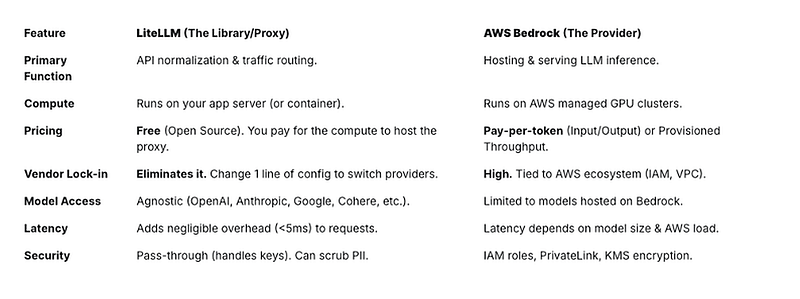
Architecture: How They Work Together
The most mature GenAI architectures use LiteLLM as the Gateway to talk to AWS Bedrock.
The “Direct” Way (Without LiteLLM)
- Codebase: import boto3
- Logic: Heavily coupled to AWS response schemas.
- Problem: If you want to test GPT-4o against Claude 3.5, you have to write a second integration.
The “LiteLLM” Way (Best Practice)
- Codebase: from litellm import completion
- Configuration:
response = completion(
  model="bedrock/anthropic.claude-3-sonnet-20240229-v1:0",
  messages=[{ "content": "Hello, world!", "role": "user"}]
)- Benefit: To switch this request to Azure OpenAI, you only change the model string. The rest of your application code remains untouched.
Reference Architecture
Client App → LiteLLM Proxy (Container) → AWS Bedrock (Claude) / Azure (GPT-4) / Ollama (Local)
FinOps & Cost Optimization
This is where the distinction is critical for growth and finance teams.
AWS Bedrock’s Cost Model
- Pure Consumption: You pay strictly for what you use (e.g., $0.003 per 1k input tokens for Claude 3.5 Sonnet).
- No “Guardrails” on Cost: Bedrock will happily scale to $50k/month if you send it traffic. It generally does not block requests based on a dollar budget (unless you build custom alarms).
LiteLLM’s FinOps Power
LiteLLM is your Cost Controller. It solves the “Who spent what?” problem.
- Unified Billing View: It tracks token usage across Bedrock, OpenAI, and Azure in a single format.
- Budgeting: You can set a budget per user or project (e.g., “Engineering Team A gets $50/day”). If they hit the limit, LiteLLM rejects the request before it goes to Bedrock.
- Cost Routing:
- Scenario: You have a simple summarization task.
- Rule: LiteLLM can route simple prompts to Bedrock Llama 3 Haiku (cheaper) and complex prompts to Bedrock Claude 3.5 Sonnet (smarter).
Implementation Checklist
If you are setting this up today, follow this path:
Step 1: Get Access. Enable model access in the AWS Bedrock Console (US-East-1 or US-West-2).
Step 2: Create IAM User. Create an AWS IAM user with BedrockFullAccess (or scoped implementation) and generate Access Keys.
Step 3: Install LiteLLM. pip install litellm
Step 4: Configure Env Vars.
export AWS_ACCESS_KEY_ID=…
export AWS_SECRET_ACCESS_KEY=…
export AWS_REGION_NAME=us-east-1
Step 5: Test. Run a simple Python script using litellm.completion targeting a Bedrock model.
Step 6 (Production): Deploy the LiteLLM Proxy Server (a Docker container) to ECS or Kubernetes to handle traffic for your whole company.
Common Pitfalls
- Thinking LiteLLM is a Model: Users often ask “How smart is LiteLLM?” It has an IQ of zero. It is a pipe. The smarts come from the model it connects to (Bedrock).
- Streaming Complexity: Bedrock’s streaming API is notoriously complex (event chunks). LiteLLM abstracts this beautifully into standard Server-Sent Events (SSE), but ensure your frontend expects the standard OpenAI chunk format.
- Region mismatch: Bedrock models are not available in all regions. If LiteLLM throws a “Model not found” error, check if your AWS_REGION_NAME matches where you enabled the model in AWS Console.
Conclusion
AWS Bedrock is the engine. It provides the raw horsepower (Claude, Llama, Titan) securely and at scale.
LiteLLM is the steering wheel. It lets you drive that engine using standard controls, switch cars easily, and keep an eye on the gas gauge (cost).
Recommendation:
If you are building a serious SaaS application, do not write raw Boto3 code for Bedrock. It ties you down too tightly. Use LiteLLM (or a similar gateway) to wrap Bedrock. You gain instant observability, cost tracking, and the freedom to switch models whenever the next big AI release drops.


