




TL;DR
- The Paradox: AI is your biggest new cost driver (“FinOps for AI”) and your most powerful new cost optimization tool (“AI for FinOps”). You need strategies for both.
- New Metrics: Stop measuring just CPU utilization. You must now track Cost Per Token, Cost Per Inference, and GPU Saturation.
- Defense Strategy: Use “Model Routing” to send simple prompts to cheaper models (e.g., Llama 3 8B) and complex ones to SOTA models (e.g., GPT-4). Implement Semantic Caching to reduce API calls by 30–50%.
- Offense Strategy: Use LLMs to clean up messy tagging data, normalize invoice line items, and provide conversational interfaces for your Cost & Usage Reports (CUR).
- The Trap: Don’t build “Science Experiments.” Ensure your AI cost analysis tools have a clear path to production value, or stick to established SaaS platforms.
The Double-Edged Sword
In the last 18 months, the cloud landscape has shifted violently. For a decade, “Cloud Financial Management” (FinOps) was about rightsizing EC2 instances, purchasing Savings Plans, and nagging developers to turn off dev environments on weekends.
Then came Generative AI.
Suddenly, engineering leaders are facing a bipolar reality. On one side, boards are demanding aggressive AI integration, leading to a new class of “unpredictable” costs — token usage, massive vector database storage, and GPU compute that makes standard EC2 look cheap. This is the challenge of FinOps for AI.
On the other side, FinOps practitioners are realizing that Large Language Models (LLMs) are uniquely suited to solve the discipline’s oldest problems: messy data, complex anomaly detection, and the inability of non-technical finance teams to query cloud data. This is the promise of AI for FinOps.
This guide is your blueprint for navigating both. We will move beyond the hype and look at the architectural patterns, metrics, and operational workflows required to master this dual frontier.
Part 1: FinOps for AI (Controlling the Beast)
“FinOps for AI” is the practice of applying financial accountability to the variable spend of Artificial Intelligence. Unlike traditional microservices, where costs scale with user requests in a somewhat predictable linear fashion, AI costs can vary wildly based on input complexity, model choice, and architectural efficiency.
1. The New Unit Economics: Tokens as COGS
In traditional SaaS, we track Cost of Goods Sold (COGS) per tenant. In AI, the atomic unit of cost is the Token.
If you are wrapping a foundation model (like OpenAI’s GPT-4 or Anthropic’s Claude) into your product, every user interaction has a direct marginal cost.
- Input Tokens: The context you feed the model (user query + RAG context + system prompt).
- Output Tokens: The generated response (usually more expensive).
The FinOps Implication:
You must implement Token-Level Attribution. You cannot simply pay a bulk OpenAI or AWS Bedrock bill at the end of the month. You need to tag every request with a TenantID or FeatureID.
Pro Tip: If your “System Prompt” is 2,000 tokens long and you send it with every user “Hello,” you are burning money. Move static instructions into fine-tuning or use prompt caching features provided by vendors like Anthropic.
2. The “Model Routing” Architecture
The single most effective way to lower AI COGS is Model Routing (or “The LLM Gateway”).
Not every user request requires the reasoning capabilities of a frontier model. Using GPT-4o for a sentiment analysis task is like driving a Ferrari to the mailbox.
The Strategy: Implement a lightweight router/classifier that sits between your user and your models.
- Incoming Request: User asks, “Reset my password.”
- Router Analysis: Determines intent is “Support/Simple.”
- Routing: Sends request to a cheap, fast model (e.g., GPT-4o-mini or a self-hosted Mistral 7B).
- High-Value Routing: If the user asks, “Analyze this financial spreadsheet,” the router sends it to the SOTA model.
Cost Impact: This pattern often reduces inference costs by 60–80% while improving latency for simple tasks.
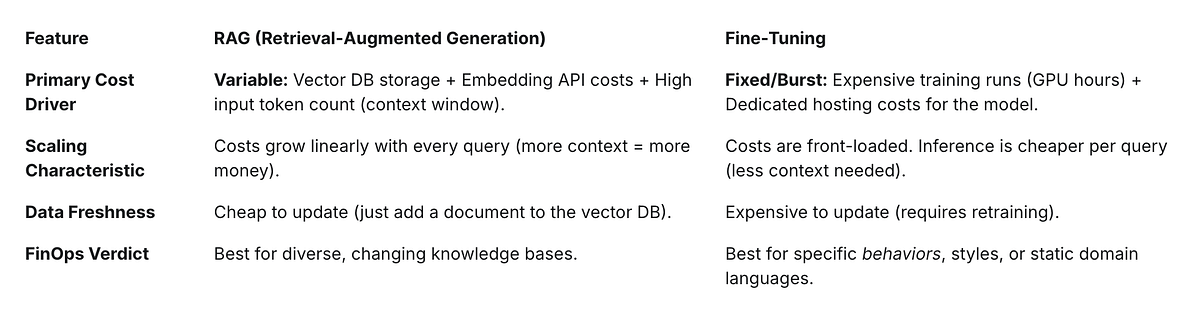
3. RAG vs. Fine-Tuning: A Cost Tradeoff Analysis
Engineers often debate Retrieval-Augmented Generation (RAG) vs. Fine-Tuning based on performance. As a FinOps leader, you must look at the cost profile.
4. Infrastructure: The GPU Optimization Checklist
If you are self-hosting models on AWS SageMaker, GKE (Google Kubernetes Engine), or Azure ML, you are managing raw GPU infrastructure. This is dangerous territory for budgets.
Spot Instances for Training: Training jobs are fault-tolerant if you implement checkpointing. Use Spot/Preemptible instances (AWS g5 or p4 instances) to save ~70%.
- Risk: Interruption.
- Mitigation: Use tools like Karpenter (AWS) or generic checkpoint scripts to save state to S3/Blob storage every N steps.
Quantization: Do you need 16-bit precision (FP16)? Often, 4-bit or 8-bit quantization (INT4/INT8) delivers indistinguishable results for inference while reducing VRAM usage by 50–75%.
- Outcome: You can fit a Llama-3–70B model on a single A100 instead of requiring two, effectively halving your hourly cost.
Orchestration Scaling: Ensure your inference endpoints scale down to zero (Serverless inference) or minimal nodes during off-hours. GPUs idling at night are the “Zombie Servers” of the AI era.
Part 2: AI for FinOps (The Offensive Play)
Now we flip the script. How can we use these powerful Large Language Models to solve the chronic headaches of cloud cost management?
Cloud bills (Cost and Usage Reports — CUR) are essentially massive, messy csv files with millions of rows. LLMs are excellent at pattern recognition and categorization within text data.
1. The “Conversational” Billing Dashboard
Executives hate logging into CloudHealth or Cost Explorer to fiddle with filters. They want answers.
The Solution: Build (or buy) a RAG-based chatbot over your billing data.
Architecture:
- Export CUR to a queryable format (AWS Athena, BigQuery).
- Use an LLM agent with “Tool Use” capabilities (e.g., OpenAI Assistants API).
- Give the Agent access to the SQL schema.
The User Experience:
- User: “Why did our database spend go up last Tuesday?”
- AI Agent: Converts natural language to SQL → Queries the data → Analyzes the delta.
- Response: “RDS spend increased by $400 on Tuesday because a new db.r5.4xlarge instance named analytics-read-replica was provisioned in the us-east-1 region.”
2. Automated Tagging & Anomaly Classification
Tagging is the foundation of FinOps, but engineers hate doing it. “Untagged” resources usually end up in a “General IT” bucket, making chargeback impossible.
AI Workflow:
Use an LLM to infer tags from resource metadata.
- Input: Resource Name: prod-marketing-website-assets, Type: S3 Bucket.
- Prompt: “Based on the name, assign a CostCenter and Environment.”
- Output: CostCenter: Marketing, Environment: Production.
AI for Anomalies:
Traditional anomaly detection uses standard deviations (Z-scores). It tells you that spending spiked, but not why.
An AI agent can look at the spike, cross-reference it with CloudTrail (deployment logs) or GitHub (commit history), and tell you:
“Spend spiked because User X deployed a CloudFormation template at 10:00 AM changing the Auto Scaling Group min-size from 2 to 20.”
3. Forecasting with Context
Linear regression (the standard forecasting method) fails when business events happen. It doesn’t know about Black Friday or your upcoming product launch.
AI models can digest multi-modal data. You can feed a model:
- Historical spend data.
- The company marketing calendar (text).
- The engineering roadmap (text).
And ask for a forecast. The model can infer: “Expecting a 15% compute spike in November due to the stated ‘Black Friday’ event in the marketing calendar.”
The Convergence: A Unified Strategy
You cannot succeed by siloing these efforts. The best organizations create a feedback loop.
The Loop:
- AI for FinOps tools analyze the spend of your FinOps for AI initiatives.
- The AI agent detects that your “GenAI Feature A” has negative unit economics (Cost > Revenue).
- The FinOps team alerts the Engineering team.
- Engineering implements Model Routing or Semantic Caching to fix the unit economics.
- The AI agent verifies the improvement in the next billing cycle.
Practical Implementation Checklist
If you want to implement this tomorrow, here is your Monday Morning plan:
Defense (FinOps for AI)
- Implement Semantic Caching: Use Redis or a Vector DB to cache LLM responses. If a user asks the same question twice, the second answer should cost $0.
- Set Token Budgets: Configure hard limits on max tokens per request at your API gateway level to prevent “runaway” loops.
- Audit Vector Storage: Are you paying to store embeddings for documents you deleted last year? Prune your indices regularly.
- Track Unit Economics: Stop tracking “Total AI Spend.” Start tracking “Cost per 1,000 requests.”
Offense (AI for FinOps)
- Deploy a Tagging Assistant: Write a script to suggest tags for untagged resources weekly.
- Stop Using Linear Forecasting: Use the ML-powered forecasting tools built into AWS/GCP/Azure Cost Explorer — they are getting much better at predicting seasonality.
- Summarize Anomalies: Connect your billing alerts to an LLM that summarizes why the alert likely happened based on recent deployments.
Pitfalls to Avoid
- The “Egress” Assassin: AI applications are chatty. They move massive amounts of text and image data. If your Model is in AWS us-east-1 and your Application is in us-west-2, or if you are calling an external API extensively from a private subnet without a VPC endpoint, Data Transfer fees can exceed your compute costs. Always co-locate models and apps.
- Spending $10 to save $1: Do not build a custom AI FinOps bot that costs $5,000/month in OpenAI API fees to find $500 in savings. Start with simple rules-based scripts before moving to generative agents.
- Ignoring “Human” FinOps: AI can find the data, but it cannot force an engineer to rewrite their code. FinOps is ultimately a cultural practice. AI supports the culture; it does not replace the conversation.
Conclusion
We are moving from the era of “Cloud Management” to “Intelligence Management.”
The winners in this new era won’t just be the companies with the best AI models; they will be the companies that can run those models sustainably. By mastering FinOps for AI, you ensure your innovation doesn’t bankrupt you. By adopting AI for FinOps, you give your team the superhuman speed needed to govern the cloud at scale.
The future of FinOps isn’t a dashboard. It’s a dialogue. And it’s time to start talking.
Ready to optimize your AI stack?
Start by auditing your current AI spend. If you are using RAG, check your “Context Window” utilization — it’s likely 40% larger than it needs to be.


